



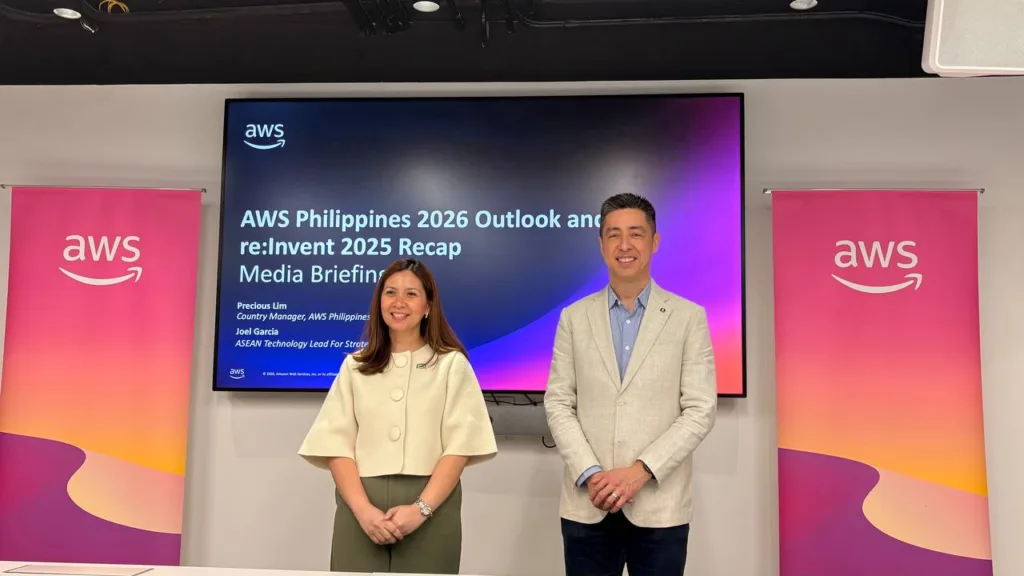
Cloud computing leader Amazon Web Services (AWS) outlined its outlook for the Philippines’ business and technology landscape in 2026 during a media briefing held on February 24 at the AWS Philippines office in Bonifacio Global City.
The session was led by Precious Lim, Country Manager of AWS Philippines, alongside Joel Garcia, Technology Lead for Strategic Initiatives in ASEAN.

Precious Lim, Country Manager of AWS Philippines
The discussion focused on the country’s accelerating digital transformation, the growing role of generative AI, and major announcements from AWS re:Invent, AWS’s annual flagship event held in Las Vegas in December 2025.
A decade of AWS in the Philippines
The briefing also marked an important milestone for the cloud computing giant in the country, as the company prepares to celebrate its 10th year of operations in the Philippines in 2026.
“This is actually our 10th year in the Philippines, so we are celebrating a decade of innovation in the country,” Lim said. “Even before that, we had already been working with lighthouse customers across banking, telco, and fintech to build and innovate on AWS.”
Over the past decade, AWS has supported organizations across industries — from e-commerce, digital wallets, ride-hailing, and streaming services to contact centers and BPOs — powering services that Filipinos use daily.
“We’re excited to continue building and innovating together with our customers, especially now in the age of AI,” Lim added.
Continued investments in local infrastructure
The cloud giant reiterated its long-term commitment to investing in in-country infrastructure to support low-latency, secure, and compliant workloads.
“In everything that we do, security is first and foremost,” Lim said. “At the same time, we want to give customers access to world-class infrastructure and capabilities.”
The company highlighted its launch of Local Zones in Manila, enabling single-digit millisecond latency for critical workloads, as well as the local availability of Amazon Connect, which allows enterprises to deploy customer experience platforms with Philippine phone numbers through local telco partners.

Hybrid cloud offerings such as Amazon EKS Anywhere and AWS Outposts are also already being used by Philippine organizations, enabling them to run latency-sensitive workloads even in remote locations.
“Our commitment will remain the same,” Lim said. “We will continue to invest in the Philippines, and we will continue to listen to feedback from customers and the government on what infrastructure is needed in-country.”
Building the Philippines’ cloud and AI talent pipeline
Beyond infrastructure, the cloud giant emphasized that talent development is a key pillar of its local strategy.
“Talent and people are super important to support digital resilience,” Lim said. “Since 2017, we’ve already trained more than 100,000 Filipinos on cloud skills.”
This training has been delivered through free programs such as AWS Skill Builder, AWS Educate, and AWS Academy. The company also pointed to the rapid growth of grassroots cloud communities nationwide, now numbering more than 30,000 members across Luzon, Visayas, and Mindanao.

The cloud giant is also working closely with academic institutions and government agencies. Ateneo de Manila University recently launched its Business Insights Laboratory for Development (BUILD) program using an AWS-powered innovation sandbox, while the Department of Science and Technology has rolled out a similar sandbox initiative focused on AI.
In partnership with Technical Education and Skills Development Authority (TESDA), AWS supports the Skills Passport mobile app, which allows Filipinos to store certificates, search for jobs, and access AI-powered assistance.
“Through the app, TESDA is able to reach millions of Filipinos nationwide,” Lim said. “Soon, AWS Skill Builder content will also be available directly in the app.”
AI adoption accelerates across Philippine enterprises
AWS shared data showing strong momentum in AI adoption across the country. According to an AWS-backed study, AI adoption in the Philippines grew 50% year-on-year, with more than 80,000 organizations already using AI in their operations.
“Sixty-four percent of organizations said they experienced revenue growth by leveraging AI, while 70% reported productivity gains,” Lim said. “By 2030, the AI market in the Philippines is projected to reach $3.5 billion.”
Local examples include banks, telcos, fintech firms, and government agencies using AI to improve decision-making, reduce costs, fight fraud, and enhance citizen services.
From generative AI to agentic AI
A major theme of the briefing was the evolution of generative AI toward more autonomous, agent-based systems.
“Generative AI is powerful and fast, but it’s reactive — you still need to prompt it,” Lim explained. “AI agents are different. They can reason, learn from proprietary data, break down tasks, and perform actions on your behalf.”
She added that enterprises are now moving toward multi-agent deployments capable of handling complex tasks such as full-stack application deployment and automated IT remediation.
“What we’ve seen over the past year is how agentic AI has really evolved and started transforming operations,” Lim said.
AWS is supporting this shift through its expanding ecosystem of agent development tools and pre-built AI solutions available via AWS Marketplace, allowing organizations to adopt agentic AI whether they choose to build or buy.
re:Invent innovations with local impact
During the session, Garcia recapped key announcements from re:Invent, including advances in autonomous AI agents, expanded model choices in Amazon Bedrock, the new Amazon Nova model family, next-generation AWS silicon such as Graviton5 and Trainium3, and enhanced data services in Amazon S3.
“These innovations are designed to help customers move from experimentation to production faster, securely, and at scale,” Garcia said.
AWS emphasized that these global innovations are already accessible to Philippine organizations and can be applied across industries — from fintech and retail to education and public services.
Looking ahead
As the Philippines accelerates its digital and AI transformation, AWS said it remains focused on enabling innovation while addressing local requirements around latency, security, talent, and data sovereignty.
“All of these are what we’ve been observing in the market,” Lim said. “AWS Philippines is ready to support the needs of our customers as they inject AI into the way they work, serve their customers, and empower their employees.”