
The Department of Education (DepEd) and Microsoft Philippines are strengthening their collaboration to address one of the country’s most pressing challenges: improving foundational literacy while preparing learners for an AI-driven future.
Under the partnership, DepEd is expanding the use of Microsoft’s Learning Accelerators — AI-powered tools designed to help students build core skills in reading, mathematics, and well-being, while also developing digital literacy and communication competencies critical for future work and learning.
Central to this effort is Reading Progress, the first Learning Accelerator adopted at scale by DepEd and now a key component of its literacy strategy. The tool has already shown promising results in pilot areas.

In Bais and Dumaguete, more than 14,000 learners across 61 schools were assessed using the platform, while in Cabanatuan City, all learners in three school districts advanced to higher literacy levels following its implementation.
Reading Progress automates reading fluency checks and generates actionable insights that allow teachers to quickly identify learning gaps and personalize interventions. By streamlining assessment and feedback, the tool also helps reduce teachers’ administrative workload, enabling them to focus more on classroom instruction and learner engagement.
DepEd, Microsoft boost literacy and AI nationwide
“Literacy remains one of our biggest national challenges, with many learners still not meeting expected proficiency levels,” said Education Secretary Sonny Angara.
“Reading Progress gives us a clear starting point to understand where our students are today, and through our partnership with Microsoft, we aim to significantly raise literacy outcomes in the coming years so every child builds the strong foundation they deserve,” the secretary further stated.

Angara said the initiative aligns with President Ferdinand R. Marcos Jr.’s Five-Point Education Agenda, which prioritizes learning recovery, learner well-being, teacher support, digitalization, and strong education governance.
The partnership is being rolled out as part of DepEd’s ARAL (Academic Recovery and Accessible Learning)program launched in September 2025. Microsoft has begun enabling educators in 25 school districts nationwide and aims to reach 3,000 teachers across 1,500 schools throughout 2026.
Beyond foundational literacy, DepEd is also moving to institutionalize responsible AI use in basic education.
AGAP.AI: First nationwide program focused on AI literacy
In January, the agency launched AGAP.AI (Accelerating Governance and Adaptive Pedagogy through Artificial Intelligence) — the country’s first nationwide program focused on AI literacy and ethical AI use in schools. The initiative targets training 1.5 million students, teachers, and parents.
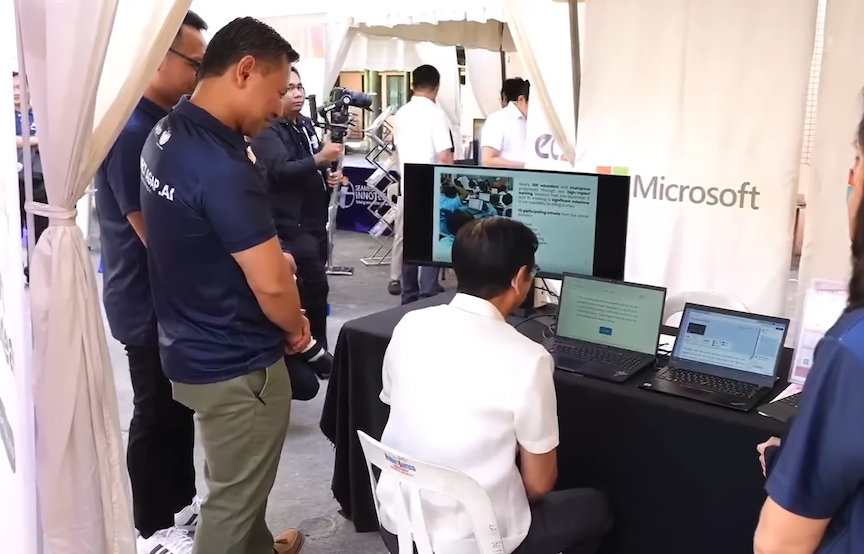
During the AGAP.AI launch at Quezon City Science High School, President Marcos personally tested Microsoft’s Reading Progress tool and achieved a score of 98 percent.
“This initiative reflects our belief that education must evolve in tandem with the changes in our world,” Marcos said. “AI is shaping how we communicate and how we solve everyday problems. Our responsibility now is to ensure that our students use AI confidently and ethically, so they can stay ahead in their learning journey.”
DepEd said the combined implementation of ARAL and AGAP.AI reflects its broader strategy of building a digitally enabled and AI-ready education system — one that strengthens foundational competencies while equipping students, teachers, and parents with future-ready skills.
For Microsoft Philippines, the partnership underscores both opportunity and responsibility.
“With thousands of schools and more than 24 million students across the DepEd system, the scale of this opportunity is truly transformative,” said Jonathan Que, Country General Manager of Microsoft Philippines.
“Our goal is to elevate national literacy in close partnership with DepEd, aligning the Philippines with the world’s highest-performing education systems. By leveraging Microsoft’s trusted platforms and solutions, we aim to empower educators, inspire learners, and unlock every Filipino’s potential,” he added.
As DepEd ramps up adoption of AI-powered tools in classrooms, the initiative positions digital and AI literacy not as optional enhancements, but as core components of learning recovery and long-term education reform — linking foundational skills directly to the country’s broader push for future-ready human capital.