
Sweeping changes in how the United States regulates digital assets are poised to reshape global crypto markets in 2026 — developments that Philippine fintech firms, exchanges, and regulators will be watching closely as cross-border trading, tokenization, and institutional participation continue to grow.
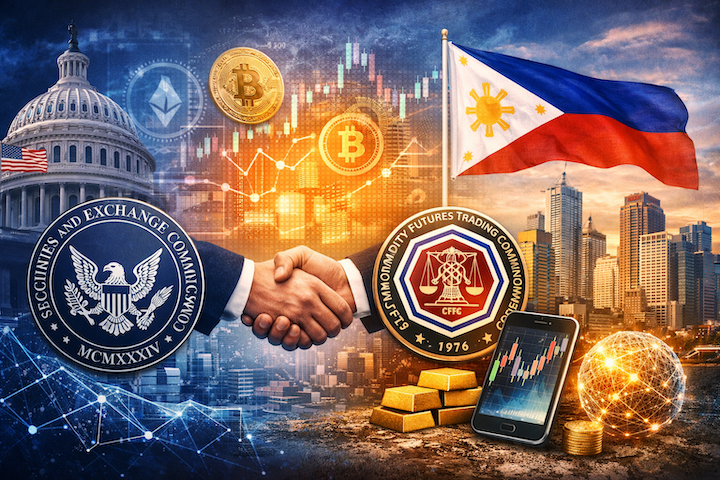
In Washington, the long-running turf war between the U.S. Securities and Exchange Commission (SEC) and the Commodity Futures Trading Commission (CFTC) over crypto oversight appears to be giving way to a more coordinated approach.
As reported in The Block, industry watchers are saying this shift could bring greater regulatory clarity to global markets, including emerging fintech hubs like the Philippines, where crypto adoption and offshore trading exposure remain significant.
From crypto turf war to coordination
For years, uncertainty over whether cryptocurrencies should be treated as securities or commodities weighed heavily on global markets. That divide began to narrow in 2025, when U.S. regulators signaled closer cooperation on crypto oversight — covering spot markets, perpetual contracts, decentralized finance, and 24/7 trading.
“For the first time in years, the SEC and the CFTC appear to be working together in a more cooperative way,” said Howard Fischer, a former senior SEC official now in private practice, noting that increased coordination is expected to drive the U.S. regulatory agenda in 2026.
For Philippine crypto exchanges and fintech platforms — many of which rely on U.S.-linked liquidity, tokens, and market infrastructure — clearer rules in the world’s largest capital market could reduce compliance uncertainty and unlock new product offerings.
SEC focus: Tokenization and exemptions
Under SEC Chair Paul Atkins, the agency is preparing an aggressive digital asset agenda that includes developing a formal “token taxonomy,” expanding exemptions for innovation, and advancing rules around tokenization — the process of bringing real-world assets such as stocks and bonds onto blockchains.
Over the past year, the SEC has approved listing standards for select crypto exchange-traded funds and issued guidance clarifying that certain staking and custody activities fall outside traditional securities rules. It has also granted limited no-action relief allowing institutions to pilot tokenization of assets like U.S. equities and Treasury securities.
For Philippine fintech firms, these moves could accelerate global interest in tokenized assets — potentially influencing local demand for crypto trading, custody, and blockchain-based settlement solutions, especially among institutional and high-net-worth clients.
Still, analysts caution that tokenization comes with regulatory and operational complexity. “Around-the-clock trading is appealing, but the implications are complicated,” Fischer said, adding that regulators face steep learning curves in balancing innovation with investor protection.
CFTC’s expanding role and market impact

IMAGE CREDIT: Cointelegraph
At the same time, the CFTC is stepping into a more prominent role. With a new chair expected to take the helm, U.S. lawmakers are increasingly signaling that the agency may become the primary regulator for crypto markets, particularly for bitcoin, which has long been classified as a commodity.
Industry leaders argue that a clearer commodities-based framework could “open the floodgates” for broader market participation. If bitcoin and other major assets trade more freely under CFTC oversight, global liquidity — including flows reaching Asian and Philippine trading platforms — could increase.
For Philippine users, this may translate into deeper markets, more stable pricing, and expanded access to crypto-linked products offered by both local and offshore platforms.
Political pushback adds uncertainty
Despite growing regulatory alignment, crypto policy remains politically contentious in the U.S. Representative Maxine Waters, the top Democrat on the House Financial Services Committee, has called for hearings to scrutinize the SEC’s decision to drop or pause major enforcement actions against large crypto firms.
Waters argued that the SEC’s recent shift toward guidance and staff statements— rather than formal rulemaking — raises concerns about transparency and investor protection.
With Democrats seen as strong contenders to regain control of the U.S. House in 2026, further political scrutiny could reshape or slow parts of the SEC’s crypto agenda.
For Philippine fintech players, this political overlay underscores a key risk: while U.S. policy signals are becoming more crypto-friendly, sudden shifts remain possible, with downstream effects on global markets and regulatory expectations.
Why it matters for the Philippines
The Philippines remains one of Southeast Asia’s most active crypto markets, driven by retail participation, remittances, play-to-earn gaming, and growing fintech innovation. Many local platforms depend on U.S.-based tokens, pricing benchmarks, and regulatory signals.
Greater clarity from U.S. regulators could help normalize crypto trading and tokenized assets globally — potentially influencing how Philippine regulators, including the Bangko Sentral ng Pilipinas (BSP) and the Securities and Exchange Commission Philippines, calibrate their own frameworks.
As 2026 approaches, Philippine fintech firms face both opportunity and challenge: aligning with evolving global standards while managing regulatory, operational, and market risks at home.
What is clear, industry observers say, is that decisions made in Washington will not stay in Washington.
For the Philippines’ fast-growing digital asset ecosystem, the next phase of U.S. crypto regulation could help shape everything from product innovation to investor confidence in the years ahead.
—
Disclaimer: This article is for news and informational purposes only and should not be construed as financial or investment advice or an endorsement of any cryptocurrency or platform. Crypto-assets are highly speculative and involve significant risks. Readers should verify the regulatory status of crypto service providers with the BSP and the SEC before making any investment or transaction.