

Security Bank Corp. is accelerating its technology transformation as it strengthens both its digital banking capabilities and balance sheet, underscoring a broader push to support growth, improve customer experience, and meet rising market and regulatory demands.
Over the first nine months of 2025, the mid-sized lender rolled out major upgrades to its core systems, adopting artificial intelligence, real-time data platforms, and enhanced cybersecurity to support faster and more reliable transactions across digital channels and branches. The technology investments reinforce the bank’s BetterBanking promise, as more Filipinos rely on digital-first financial services.
The transformation comes as Security Bank returns to the capital markets with the issuance of another five-year fixed-rate bond, a move the bank said reflects investor confidence in its financial position and long-term strategy.
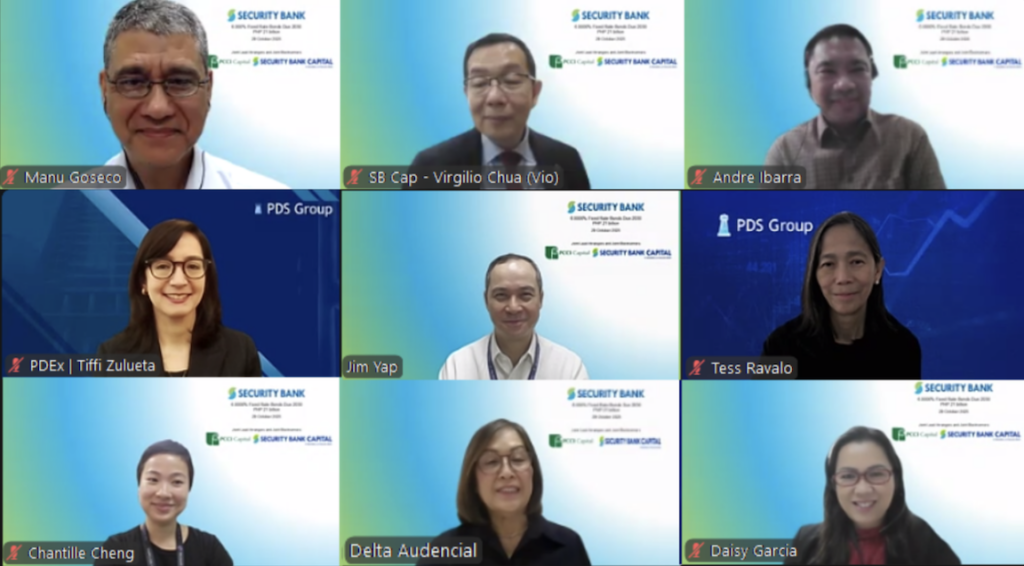
Speaking at the bond listing, Philippine Dealing and Exchange Corp. (PDEx) President Stephanie Marie Zulueta highlighted Security Bank’s solid financial standing and governance track record. She noted that the bank posted an 8% increase in net income and a 23% rise in revenues in the first half of the year, alongside multiple recognitions for transparency and sustainability.
“This year, the bank was once again honored by Corporate Governance Asia, receiving six awards at the 15th Asian Excellence Awards,” Zulueta said, citing Security Bank’s continued focus on accountability and good governance.
Technology upgrades with real-world impact
Within the bank, the modernization of key systems has improved transaction speed, reduced service disruptions, and simplified internal processes, particularly in compliance and operations. Customers are seeing smoother digital experiences and quicker processing times, whether banking online or transacting at branches.
As digital adoption accelerates across the Philippines, banks are under increasing pressure to respond in real time while safeguarding customer data. Legacy systems can slow innovation and constrain growth—risks that Security Bank aims to address through its multi-year technology roadmap.
APIs, data, and compliance at the core
A central pillar of the bank’s digital strategy is its Enterprise API Platform, which recently won the Technology Excellence Award for API–Banking at the 2025 Asian Technology Excellence Awards. By using application programming interfaces (APIs), Security Bank can roll out new services faster, maintain consistent experiences across channels, and prepare for open banking and fintech partnerships.
The bank has also digitized its compliance workflows through its Transactor Due Diligence platform, now deployed across all 346 branches. The system fully automates know-your-customer checks, cutting processing time, strengthening controls, and reducing paper use. The initiative was recognized as Best Compliance Risk Technology Initiative at The Asian Banker Global Financial Technology Awards.
On the data side, Security Bank shifted from traditional batch processing to real-time data streaming. Its Data Streaming Platform, named Best Data Integration and Framework Initiative in Asia Pacific, enables teams to access live insights, support faster transactions, and make better decisions using real-time information.
Supporting growth and market confidence

Security Bank said its recent bond issuance plays a key role in managing its balance sheet while supporting the sustained growth of its asset base.
“This transaction reflects the market’s continued confidence in Security Bank,” said Price Edward “Jim” Yap, executive vice president and head of the bank’s Financial Markets segment. “More importantly, it allows us to better manage our balance sheet and support the sustained growth of our asset base.”
PDEx data shows strong momentum in the debt market, with total listings and enrollments reaching nearly PHP 392 billion year-to-date, close to the PHP 400 billion mark. Financial institutions account for more than 61% of total listings, while secondary market trading continues to average around PHP 1 trillion monthly.
What’s next for Security Bank?

Security Bank said it will continue investing in artificial intelligence and automation for fraud management and operations, advanced cybersecurity, core banking and payments modernization, expanded API partnerships, and deeper digitalization across branches and back-office functions.
“Security Bank is building a modern, secure, and customer-centric foundation designed to support sustainable growth while continually improving customer experiences,” said Lucose Eralil, executive vice president and chief operating officer of Security Bank.
“Our progress reflects disciplined execution and a forward-looking approach, and these recognitions reinforce the strength of the transformation we are delivering.”