The Philippines is on track to become a global testbed for tokenized investments, with a new report projecting a US$60-billion market for digital assets by 2030.
According to the white paper for “Project Bayani,” published by the Philippine Digital Asset Exchange (PDAX) in partnership with Saison Capital and Onigiri Capital, the country’s extensive adoption of blockchain-enabled mobile wallets positions it for rapid growth in tokenized public equities, government bonds, mutual funds, and other financial products.
The report estimates that tokenized public equities could account for US$26 billion of the market, government bonds US$24 billion, mutual funds US$6 billion, and other assets US$4 billion. Crucially, these estimates are seen as a starting point rather than a ceiling, highlighting the untapped potential of the nation’s digital-first economy.
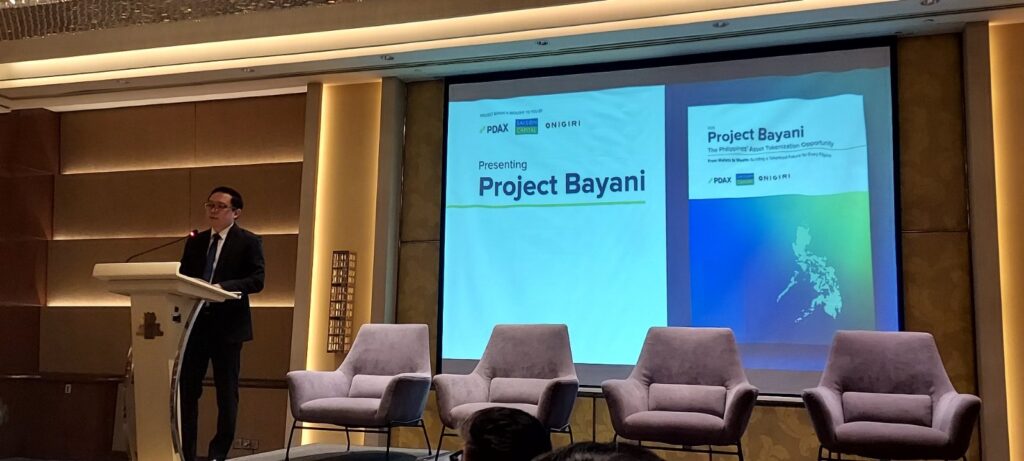
Kenneth Chua, Chief Business Development Officer of PDAX, providing an overview of the report
Tokenization as a tool for inclusion
“Tokenization in the Philippines is about more than just digitizing existing financial products; it’s about expanding access to underserved populations,” the report notes. With millions of Filipinos still excluded from traditional investment platforms, blockchain wallets such as GCash, PDAX, Maya, and Coins.ph are enabling broader participation in financial markets.
“The Philippines has a unique advantage: blockchain wallets are already mainstream,” said Nichel Gaba, founder and CEO of PDAX. “We’re not starting from scratch. The infrastructure to deliver tokenized assets to millions of Filipinos already exists in their pockets. Our focus now is to connect that infrastructure to real, regulated financial products.”
Currently, 14% of Filipinos own cryptocurrencies, dwarfing traditional investment ownership, with stocks at 2.4%, bonds under 1%, and mutual funds under 1%. Project Bayani suggests that tokenized assets could become the default first investment for many new investors.
Government bonds go digital
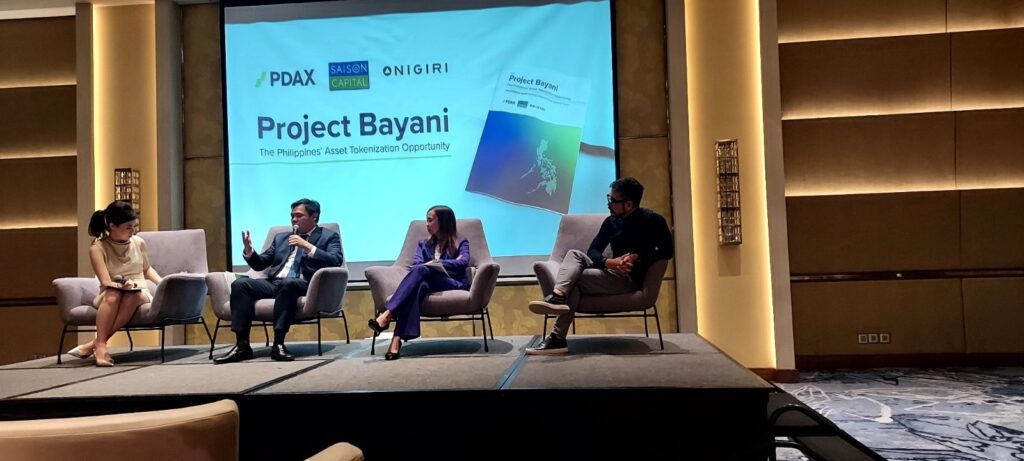
Event host Mimi Ong with Nichel Gaba (CEO & Founder of PDAX), Sharon Almanza (National Treasurer, BTr), and Luis Buenaventura (Head of Crypto and VP of GCash) during the panel discussion.
The report cites the Bureau of the Treasury’s (BTr) partnership with PDAX and GCash as a proof point for how tokenization can democratize access to financial instruments.
Since its launch in November 2023, Tokenized Treasury Bonds have allowed retail investors to participate with a minimum investment of just ₱500, bringing government bonds directly to the fingertips of millions of Filipinos.
“This partnership represents a bold leap forward in democratizing access to public financial instruments, further promoting financial inclusion,” said National Treasurer Sharon P. Almanza. Nearly half of all government bond account holders now own them in tokenized form, signaling strong potential for mass adoption.
A digital-first future for Philippine finance

Nichel Gaba, CEO and Founder of PDAX, delivering the closing remarks
Major wallets already embed blockchain-enabled functionality, allowing users to hold crypto and tokenized assets without the need for new distribution channels or legacy infrastructure.
“What makes the Philippines extraordinary is not just its adoption of blockchain technology, but how deeply it is integrated into daily life,” said Qin En Looi, managing partner of Onigiri Capital and partner at Saison Capital. “With wallets as the primary financial interface for millions, tokenization is a natural next step in how Filipinos save, invest, and build wealth.”
Project Bayani further underscores the country’s growing leadership in global fintech innovation. By integrating tokenization into its capital markets, the country is showing how emerging technologies can modernize financial systems and expand people’s participation in investment products through digital transformation. This unlocks financial inclusion and market penetration that few mature systems can match.
As the country continues to integrate blockchain into everyday financial activities, tokenized assets are poised to complement and, in some cases, overtake traditional investments, offering a scalable, inclusive pathway to financial empowerment.
—
Disclaimer: This article is for news and informational purposes only and should not be construed as financial or investment advice or an endorsement of any cryptocurrency or platform. Crypto-assets are highly speculative and involve significant risks. Readers should verify the regulatory status of crypto service providers with the BSP and the SEC before making any investment or transaction.